This is an interesting article by Jonathan Zimmerman regarding why he thinks American students still lag far behind Asian students in standardized test scores. Influencing children to work hard and overcoming setbacks is much more important than promoting their self-esteem.
January 4, 2011

August 22, 2010
Mentors and Role Models
My mother used to say, “If you hang around with dogs, you’re bound to get some of their fleas.” Likewise, association breeds assimilation in the positive direction. No matter what the desired needs of the group, people will bind themselves to the chemistry and system of whatever group they are placed. My main focus with the rookie members of any team is to place them with those older role models who will constructively teach them and guide their efforts. Unfortunately, if the leader is a bad one, a good ship can go down.
The Christian men’s group, “Promise Keepers” has a great concept about mentoring. As described in some of their programs, each person should have three types of friends in their lives: a Paul, a Barnabus, and Timothy. This means that for the most growth to take place in one’s life, it is important to have someone good above you as a teacher (a Paul). It is equally important to have someone important in you life who is on an equal status and will hold you accountable for doing the right thing even the pressure is on (a Barnabus). He or she provides a tough-love friendship, because sometimes our vision gets foggy on the way up a tough mountain. Finally we need to consider the importance of being a teacher ourselves – passing on the truths that are critical for success and a good life. We need to pick someone who we mentor to (a Timothy). These three people – Paul, Barnabus and Timothy – are all taken from scripture and illustrate a fantastic concept for learning at any level and for any challenge.
July 14, 2010
I Will Miss Danny Daniel
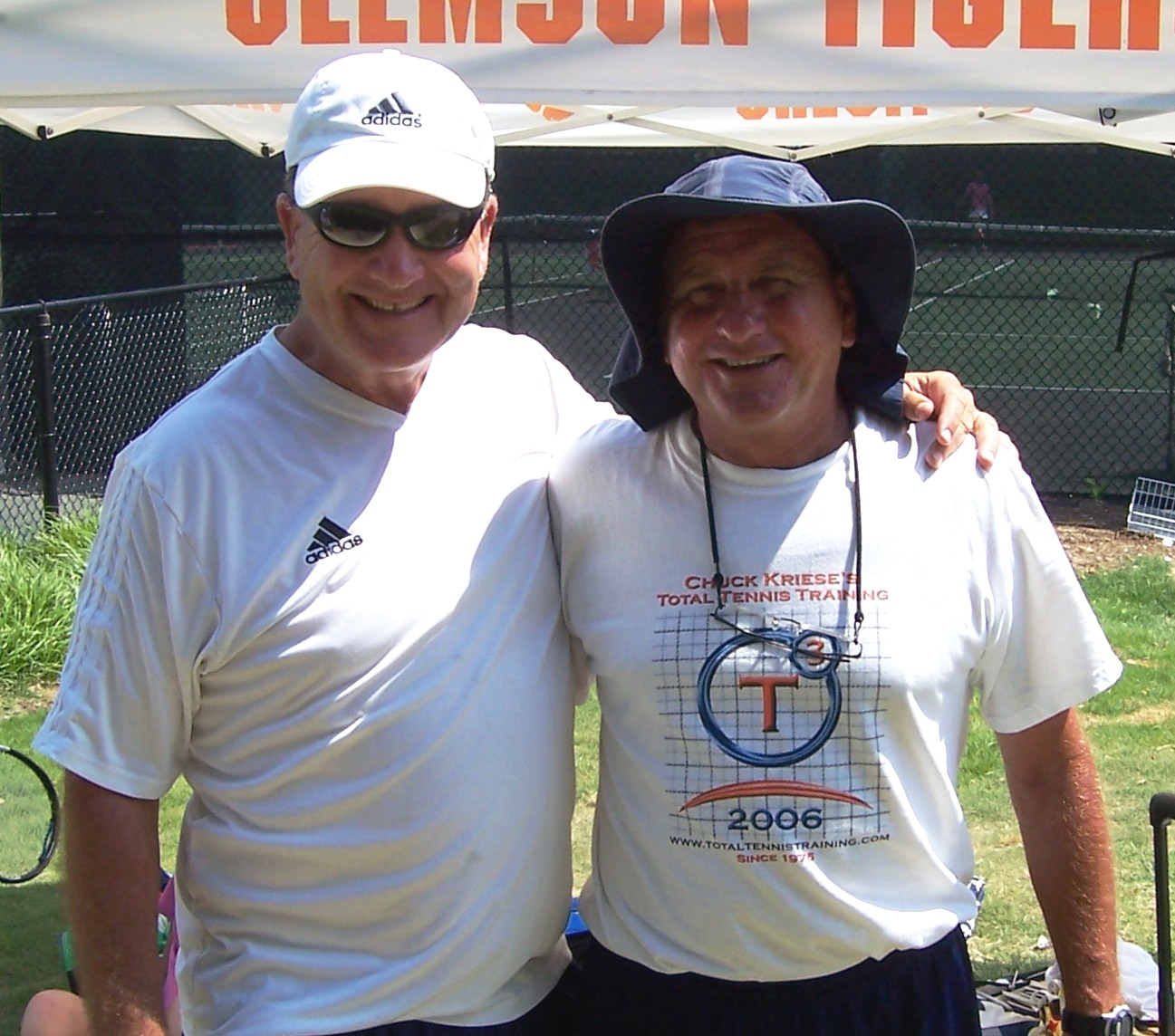
As I get ready to start my camps this summer, I am thinking of my good friend Danny Daniel and how very much I miss him.
What a man he was... He was the type of person that you just wanted to always be with. He was never pretentious or shrewd - just a humble servant to others and one of the best coaches and teachers that I have ever been around.
Every day that he worked with me, even without saying a word, he sparked a new life and focus into myself and the staff. He reminded us why we taught children. Why it was one of the most honorable professions.
I met Danny in Lavonia Georgia in the early ‘90s. He was the local high school as a football coach and also helped with the tennis team. He and a lady named Sandy Adams had a great thing going there. On a Saturday in that rural Georgia town, I gave a clinic to 50 tennis-hungry kids.
After that meeting, Danny started helping me with my summer camps. As soon as his son Clark was old enough to hold a racket, he would bring Clark up for a few weeks and have a father-son experience in tennis. Danny would help me with managing and teaching the kids while his son participated in the camp. It was touching to see the bonding experience between Danny and Clark. They shared everything: the nights in the dorm room, the meals in the cafeteria, the walks to and from the courts, and many many laughs. They shared one of the best father-son relationships that I could imagine.
Danny had this very crooked and very ugly pinky finger that had not been properly set when it was broken. At camp, it was fun to show the kids this finger and tell them that, as a child, Danny had not used the proper volley or service grip. We would later laugh as we would talk about the wonderful innocence of children as many of them would, at first, believe such a yarn. Those moments, over a meal or a bowl of popcorn with Danny, were so much fun. He loved popcorn almost as much as I did.
Danny soon became the Camp Manager, and he would always make sure that everyone was where they had to be when they had to be there. He was not only very organized, he also knew how to make the camp experience wonderful for each and every child. Very few teachers can balance of getting many complex things done while keeping everyone at ease and having fun.
Danny mostly reminded me of the wonderful experience of teaching and coaching young people. Simply, he just loved teaching and he loved to coach, and he loved tennis as much as anyone that I have ever met. Serving each and every child was his only agenda. Such service became contagious. He taught us by example.
When Danny died earlier this summer, I called several of the coaches and instructors that had worked with us at the camp over the years. I remember a couple of them start to cry when I told them about Danny. As I write this now, I am starting to tear up as well.
What a man… What a man's man... Not for his toughness, as he was very tough as a coach and as a tireless worker. But more so, he was a mans' man because he was a person that calmed your heart and made you just know that deep-down, things were OK.
There was a bigger, more important reason for why we taught these children - more than just for the sport or making a living during the summer. He balanced the roles of a servant and a teacher of others while still maintaining his strength and dignity and honor. He was non-assuming and giving and deeply caring for those around him. We will all miss him so very much.
After each day of work this summer as I have that popcorn, that reward after a long and hot day in the sun with the children, I will think of him.
To Cindy, Laney and Clark… my prayer is that God spares your tears… and you start to laugh each and every time that you start to cry… I do.
The Value of Perseverence
Perseverance is a virtue that enables athletes to never quit, no matter how great the adversity. Athletes must be willing to hang in there and keep trying long enough to see the fruits of their labor.
One of the best examples of perseverance I've seen was a college match played by Kent Kinnear. In my coaching career, I had seldom seen a player getting so dominated. His opponent, from the University of Tennessee, was playing so great that Kent managed only six sporadic points in the first set. In 25 short minutes, Kent lost 6-0.
It's not that he was playing poorly, but his opponent was pulling off a constant barrage of incredible shots. Kent was feeling outmatched. As he went down a service break in the second set, he shook his head in disgust and said, "I don't know what to do."
"You really only have two choices," I replied. "You can quit or keep trying. Believe in what you do best, and do your best to execute it."
When things are going poorly it is so hard to keep trying, but through perseverance, the competitor will gain courage.
Kent did somehow hang in long enough that day. It started with a few points, here and there, going right. Eventually, little by little, the momentum shifted. This frustrated his opponent, and, by the end of the match, a complete reversal had taken place. Kent won.
When he came off the court he said to me, "All I was trying to do was to do the small things as well as I could, such as making first serves and being in the proper position. When I was losing, it felt like I was sliding down the mountain ten yards at a time. Things were going so fast. It was discouraging. Climbing back into the matching was like moving back up the mountain one inch at a time. It was long and hard, but I'm glad I didn't quit."
July 6, 2010
Former Player Named Head Men's Tennis Coach at South Carolina

Josh Goffi has been named the Head Men’s Tennis Coach at the
This is from ClemsonTigers.com:
A
Goffi joined the men's tennis staff at Duke in July 2008. Prior to his two-year stint at Duke, Goffi was an assistant coach with the
After completing a standout collegiate career at Clemson in 2001, Goffi played on the ATP Tour through September 2005. During that stretch, he claimed a pair of singles titles and 18 doubles championships. Ranked as high as No.
As a three-time All-ACC selection for the Tigers, Goffi was the ACC's singles and doubles champion in 1999 and was a member of the 2000 and 2001 NCAA All-Region teams. He rose as high as No.
Goffi graduated from Clemson in 2001 with a bachelor's degree in financial management. He is married to the former Nancy Augustyniak, a former
June 7, 2010
Two Different Personalities
Two different personalities prevail in competitive sports: 1. The diligent, hard worker. 2. The person who is loose-as-a-goose. The former is obsessive and driven. He practices skills again and again until he does them correctly. The latter is a cocky competitor who thinks he can do it all.
Most coaches love to work with the first kind - the driven temperament athlete. One problem, however, is that on game day this athlete usually tries too hard and often chokes.
Though cocky athlete may give the appearance that he will pull off a win, because he may lack the foundation of repetitive work, he often is not able to come thorough in the clutch. Nor can he be counted on for consistent performances.
Sports psychologists Bill Moore explains that the arousal levels for practice days and match days should not be the same. It would best if a player's personality were a combination of the two personalities - an ideal balance of someone who is driven on practice day - doing everything possible to polish his skills - and someone who, on game day, is able to approach the competition with a confident attitude. But most athletes tend to be one way or the other.
On game day, it is best to use shots that are your medium risk shots - those with which you are comfortable. Attempting to make high risk shots over and over invites inconsistency.
When preparing for a big match, some sayings to remember are:
"Regular stuff is good enough."
"Try softer, not harder."
"Desire a total release performance more than you desire to win."
Even if an athlete knows what level of emotional arousal produces the best performance, he or she may not be able to compete comfortably at that level. Each athlete must find his or her unique zone of emotional balance for competition.
Nick Saban
Coach Nick Saban - Complete Speech January 25, 2010 from The Pacific Institute on Vimeo.
Subscribe to:
Posts (Atom)